




How did we completely eliminate sorting errors through efficient integration?
Company Case Study
30 packages per month went to the wrong courier. Annually, that's 365 mis-sorted shipments. Each one meant a complaint, additional handling, and an operational cost. It also meant delivery delays, strained B2B relationships, and a drop in end-customer satisfaction.
In this case study, we show you how we eliminated the cause of errors without costly replacement of the entire sorting line.
Critical point of the entire process
The first step was to eliminate the source of errors. The problem wasn't due to a lack of employee commitment. The source of the errors was the last sorting stage, where the operator made the decision to assign a package to a courier. With high volume and long working hours, a decrease in concentration was inevitable.
Automation that completely eliminates human error
Since the source of errors was a manual decision made at the end of the line, the solution had to be to move this stage to an automatic system. Together with the client, we decided to implement a sorter equipped with a barcode scanner, which takes over the process of assigning shipments to the correct courier.
How does it work?
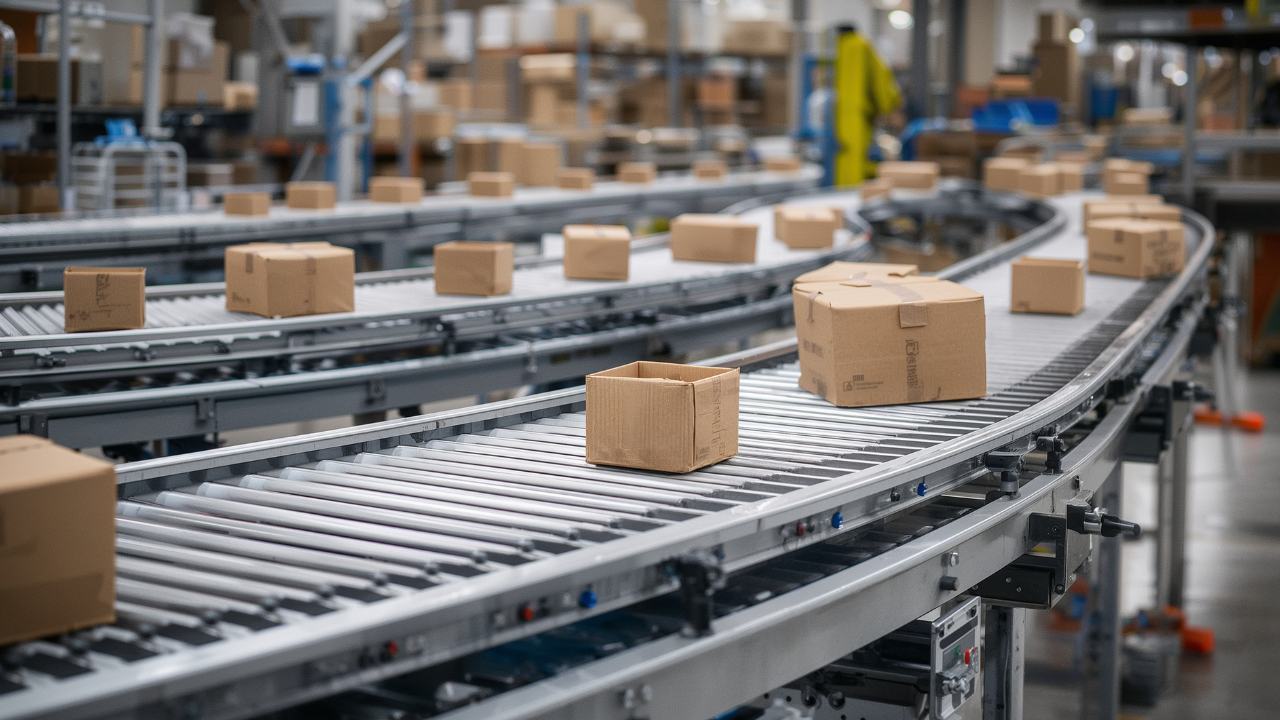
The scanner reads the label in a fraction of a second, the system identifies the correct direction, and the package is automatically sent to one of eight lanes assigned to operators. The employee's role is limited to overseeing the process, and the decision to assign the package is made automatically, without human intervention.
The choice of this solution was obvious from a process perspective. However, Its integration with the existing sorting line proved to be a real challenge.
How to implement a new solution without a costly line overhaul?
At Intralog, we believe the integrator's role doesn't end with machine delivery, and our main goal is to solve business problems. For the company, the challenge wasn't the selection of the sorter itself, but its seamless integration with existing infrastructure.
Connecting a new sorter with an existing conveyor is always an area of increased risk. It is precisely at the so-called „interfaces” that the success of the entire project is determined. In this case, a gap appeared at the junction of the two systems, which disrupted the smooth flow of smaller packages, and standard, ready-made integration solutions proved incompatible. Theoretically, the only solution could have been the costly replacement of a fragment or the entire existing line. However, from a business point of view, this would have been unjustified. After all, the role of automation is to generate savings, not to force unnecessary investments in efficient infrastructure.
The final solution? In-house integration, meaning the implementation of a dedicated solution
We decided to solve the problem exactly where it originated. Our engineering team developed an integration module designed for the specific geometry of the line and its unique operating conditions. company warehouse, for which We designed and manufactured a custom insert, reducing the gap between conveyor belts and restoring the smooth flow of shipments. This was neither a catalog item nor a standard integration component. Thanks to our engineering background and production workshop, we were able to proceed from diagnosis to implementation without engaging external subcontractors and without generating additional downtime. In such situations, the difference between „boxed” integration and engineering intralogistics becomes visible. At Intralog, we don't expect existing infrastructure to be perfect. We design solutions that work in real, often imperfect, warehouse conditions.
Our recipe for effective automation? Efficient integration
Automation allowed for the complete elimination of human error at the source, and thanks to Intralog's engineering support, it was possible to seamlessly integrate the new solution with the existing infrastructure, all without costly reconstruction of the production line.
Do you want to know which elements of your sorting process are worth automating and where integrating new solutions will bring the greatest business impact? Contact us.