




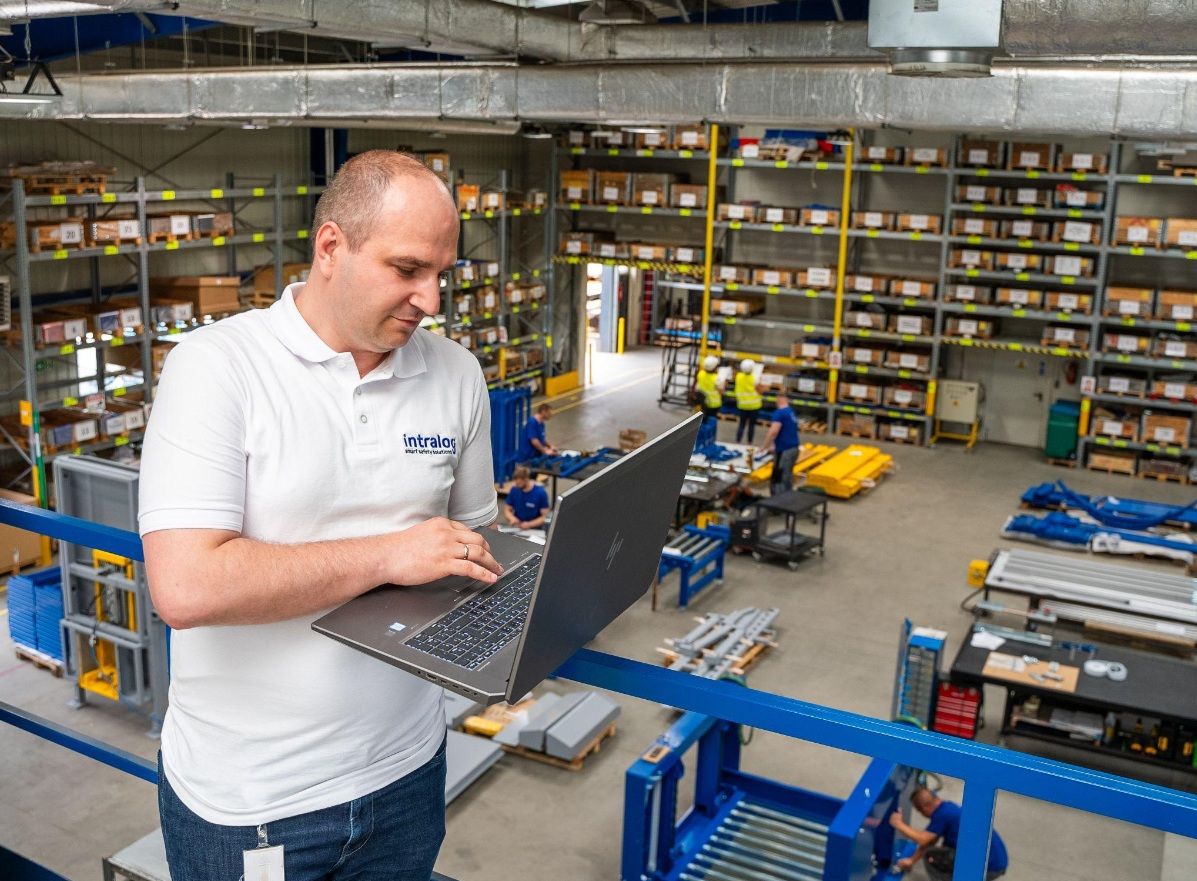
Discussion on warehouse modernization, process consolidation, and intralogistics design for further growth.
Interview with Łukasz Białek, Member of the Management Board and Chief Operating Officer at Intralog, responsible for the technical area.
Let's imagine this situation:
Your company is growing. Orders are increasing. The natural need arises to rent another hall, increase the number of employees, and reorganize individual processes. At first glance, everything seems to be going smoothly. The problem arises when an increasingly large portion of the organization's energy is no longer being allocated to business development, but begins to focus on maintaining current operational liquidity.
Intralog's experience shows that as companies grow, they begin to lose not only warehouse space but, above all, control over the fluidity of operations. Additional halls solve the problem temporarily, while simultaneously increasing the complexity of processes.
At this point, it's worth asking ourselves: when does modernizing the current warehouse still make sense, and when should an organization start preparing for the consolidation of operations and the construction of a new facility?
In a conversation with Łukasz Białek, we discuss the most common problems encountered when scaling warehouse operations:
- How can you tell that a warehouse is starting to limit development?
- Why do companies fall into the trap of dispersed operations?
- At what point does the next hall stop solving the problem?
- What are the most common mistakes that occur when scaling logistics infrastructure?
If your organization is facing a decision today about modernization, expansion, or reorganization and wants to do it wisely, this material is for you.
Karolina Białas, Marketing Business Partner: Łukasz, let's talk about the moment when a warehouse stops supporting company growth and starts becoming an operational limitation. What are the most common signs that the infrastructure is no longer keeping up with the scale of the business?
Łukasz Białek, Technical Director Intralog: If I had to answer your question in one sentence, I would say that one of the first signs is the need to rent additional warehouse space. This most often results from emerging capacity limitations. Pallet spaces start to run out, the shipping zone can't keep up with the number of orders, and the flow of goods between individual processes loses its smoothness. Of course, companies then rent an additional hall, move part of their operations, or reorganize selected warehouse zones. Initially, such actions actually help. The problem arises when subsequent locations start to generate more organizational work than real operational benefits. At some point, the company focuses more on maintaining consistency of operations than on further scaling the business.
You mentioned dispersing operations across multiple locations. What are the most common problems that start to emerge with this type of operating model?
The costs associated with transportation, process coordination, and goods flow management between warehouses are the most common. Ultimately, managing this entire system becomes one of the biggest pain points for organizations. Therefore, in many cases, consolidating operations proves to be a more effective solution. under one roof. A large warehouse allows for more flexible management of space, processes, and work organization depending on the current load of individual zones.
When should an organization start considering consolidating operations and a new facility, and when is it still worthwhile to modernize existing infrastructure?
It is primarily a matter of the scale of growth and the actual source of the operational problem. If a company is growing by 20–30% year over year and the current warehouse can no longer accommodate new operations, it is still worth trying to modernize it. However, once the organization is already operating out of four warehouses and there is a need to launch a fifth location, it is worth seriously considering consolidating operations into a single location. Leasing multiple smaller spaces very quickly increases operating costs. Why? Because each location requires separate equipment, a team, forklifts, and additional coordination of processes and transportation between facilities. In many cases, organizing operations in a single facility—such as a 45,000-square-meter warehouse—proves to be a more effective solution. This model allows for more flexible management of both space and workflow. There is no need to maintain a dispersed logistics infrastructure.
And when can we think about modernizing the warehouse?
We decide to upgrade when the business is relatively stable and the warehouse begins to lose efficiency in terms of throughput and process fluidity. In many cases, the problem does not yet concern the warehouse space itself. The limitation starts to be a specific stage of operations, the layout of zones, or the way goods flow is organized. In such situations, there is no need to build a new facility yet. Optimizing processes and reorganizing current infrastructure brings a much greater effect.
Could you provide an example of a project undertaken by Intralog where, instead of building a new warehouse, you chose to modernize processes?
An example from our experience is the company DTW. They carried out shipments based on a warehouse equipped with about 60 packing stations. The process was very simple. Employees would place finished products on conveyor belt, and then four or five people would manually sort each package based on courier labels and place it on the appropriate pallet. With a volume of around 2,000 shipments per day, the system worked correctly. The problem arose when the number of shipments began to grow dynamically. First to 5,000, then 10,000, and then 15,000 shipments per day. The company tried to increase human resources. The sorting team was increased from four to twelve people, but the problem continued to worsen. More and more errors and mistakes occurred.
What solution did you implement?
The modernization involved implementing an automatic sorter. Packages were mechanically moved, scanned, and automatically directed to the appropriate zones. The effect was practically immediate. The number of errors dropped to almost zero, and efficiency increased from approximately 2,000 packages per day to approximately 2,000 packages per hour. This allows the client to handle up to 48,000 shipments per day across three shifts today, achieving a significant development buffer for the coming years. We always strive to design solutions with adequate performance capacity, of course within the client's budget.
Can a well-designed upgrade significantly extend the time before a company needs to consider building a new warehouse?
For a while, yes. However, if a company is growing steadily by 20–30% annually, moving to a much larger facility will eventually become a natural step in its development. It is also important to distinguish between business models. Companies operating as 3PL providers, such as e-commerce fulfillment providers, typically sign multi-year contracts and tailor their operations to specific volumes. In their case, modernization very often pertains to a specific period of cooperation. The situation is different for organizations operating for their own needs, such as companies with their own, predictable product and a stable sales model. In such cases, it is much more common to expand and improve the current facility rather than move operations to a new location. In contrast, for a rapidly growing business, modernization itself is usually a temporary solution. At some point, the scale of operations will inevitably necessitate further infrastructure expansion.
Does modernizing a warehouse always mean a big investment?
Not necessarily. Many improvements can be implemented at a relatively low cost. A good example is container unloading. By implementing flexible telescopic conveyors or extenders, goods flow can be significantly sped up without the need for building permanent external infrastructure. This is exactly an example of simple, yet very effective, low-cost modernizations.
What other relatively low-cost improvements can be implemented in phases today, without the need to build a new facility?
Increasingly, these are partial automation of selected warehouse zones. Automated receiving and sorting of goods allows for the reallocation of labor resources to other processes. Automated stacker cranes that deposit and retrieve resources from racks are highly effective in storage zones. This eliminates the need for organizations to rely solely on traditional forklifts and the additional hiring of certified operators. Solutions supported by autonomous robots, capable of independently retrieving specific items from racks and delivering them to assembled orders, are also being implemented. Importantly, all these solutions can be implemented gradually within an existing warehouse.
And what about a situation where a company needs to implement optimizations and increase operational efficiency today, but at the same time knows that the current warehouse will only be a solution for the next two or three years?
This is a very common scenario. Many clients assume from the outset that their current location will only be a temporary solution. Our design discussions with clients are based on these assumptions. It then becomes crucial to design systems with future relocation and further scaling of operations in mind. At Intralog, we create modular solutions right from the implementation stage that can be expanded, reconfigured, and moved to new facilities in the future. This means that infrastructure designed today for current processing capacities does not lose its value after a change of location. The system can be dismantled, transported, and re-implemented in a new facility with a completely different operational layout.
Can you give me an example?
Of course. A system designed today in an example „L” configuration can be transported to a new facility after disassembly and redeployed as a modified „C” configuration, adapted to a completely new hall layout and a larger scale of operations. This is the advantage of modular systems. They do not „age” once they leave a warehouse. They can be seamlessly expanded and adapted to subsequent stages of an organization's development. In practice, this means that a hardware base currently handling, for example, 500 totes per hour can be expanded in the future to a system handling even 1200 totes per hour, without the need to design the entire infrastructure from scratch.
So flexibility in systems becomes key today. Earlier, you mentioned that with dynamic growth, a new location often becomes unavoidable. What mistakes do you warn companies against at the stage of designing a new warehouse?
One of the biggest mistakes is copying an old operational model to a new space 1:1. A new warehouse means completely different conditions. Very often, companies design a warehouse based on the current process layout, instead of starting by defining the target throughput and scale of operations they want to achieve. Another mistake is also choosing a location without prior analysis of the local labor market. Organizations very often assume that employees will automatically move to the new facility. In practice, it looks completely different.
So the problem can arise even before the organization begins the actual relocation?
Precisely. The next challenge is planning the move of operations. I know of cases where clients have been able to relocate their entire business to a 40,000-square-meter facility within a single weekend. They would finish work at the old site on Friday and launch operations at the new location on Monday without interrupting supply continuity for customers. However, this requires perfect planning. Moving operations „on the fly,” without prior preparation of infrastructure, IT systems, shelving, or automation, generates enormous risks for the entire business.
Łukasz, I have a feeling we could talk about these mistakes for a very long time, because behind each such decision lies the immense complexity of processes, people, and the entire operational model. However, one thing is clear from our conversation: effective intralogistics begins much earlier than at the stage of purchasing shelves or automation itself. It requires a broader, long-term perspective, and above all, from the perspective of the organization's further development.
Absolutely. In intralogistics, every decision concerning processes, infrastructure, or automation impacts how an organization will function for the next several years. That's why designing flexible, scalable systems ready for further business development is so important to us.
Thank you for the conversation!
Thank you.
If your organization is facing a decision today regarding warehouse modernization, operations consolidation, or the design of a new facility, it's worth looking at this process more broadly than solely through the lens of current operational needs.
Talk to Intralog experts and find out how to design warehouse operations with future business scaling in mind.
SPEAKER BIO NOTE:
Lukasz Bialek
Board Member and Chief Operating Officer Intralog. Responsible for designing systems that enhance the efficiency and scalability of warehouse operations. Supports companies in automation, infrastructure modernization, and logistics process optimization.