




How did we eliminate human errors and seamlessly integrate the new system with the existing line?
Case study: DTW Logistics
At first glance, everything worked like clockwork. The sorting process was efficient, sales volume was high, and the number of errors was low. On the borderline of statistical error. On a monthly basis, this meant about 30 shipments went to the wrong courier. For most large-scale organizations, this is too low a number to be considered a real operational problem.
Not entirely. In this case study, we'll show you how automation makes it possible to eliminate errors at the source and how we implemented it without a costly infrastructure overhaul.
Statistical error costs more than you think
We will show this with the example of our client, DTW Logistics, a logistics operator providing services in contract logistics, international transport (FTL and LTL), domestic distribution, sea and air freight, and customs clearance. The company operates in the European and global markets, carrying out large-scale processes.
Problem? 30 shipments went to the wrong courier. From an operational perspective, these were isolated incidents, within an acceptable margin of human error. It is, however, worth looking at this situation from an operational perspective, not just a statistical one.
30 errors does not mean 30 one-off events. It means 30 complaints, 30 interventions by the warehouse and customer service team, as well as time spent locating shipments, correcting documents, and contacting courier companies. It also means delivery delays, strained B2B relationships, and a decrease in end-customer satisfaction. On an annual basis, an „insignificant statistical error” generates hundreds of hours of work and a cost that accumulates over time.
Implementing automation is key to eliminating human error
The source of errors was not in the technology or the lack of procedures. The problem occurred at the final stage of the process, where a human made the final decision. Over many hours of work, the operator had to read labels, analyze information, and assign shipments to the correct courier. As time passed, concentration naturally decreased, and in such conditions, human error becomes a statistically unavoidable element of the process.
Our solution? Automatic sorter equipped with a barcode scanner
Since the source of errors was the last stage of the process, it was crucial to eliminate work that depended on the operator's concentration. We proposed Implementation of an automatic sorter equipped with a code scanner, who took responsibility for assigning the shipment to the correct courier. The scanner reads the label in a fraction of a second, the system identifies the correct direction, and the package is automatically directed to one of 8 tracks, assigned to specific carriers. In principle, everything sounded simple and logical. However, in practice, every such implementation has its Moment of truth.
Challenge? Implementation of a new system on an existing line
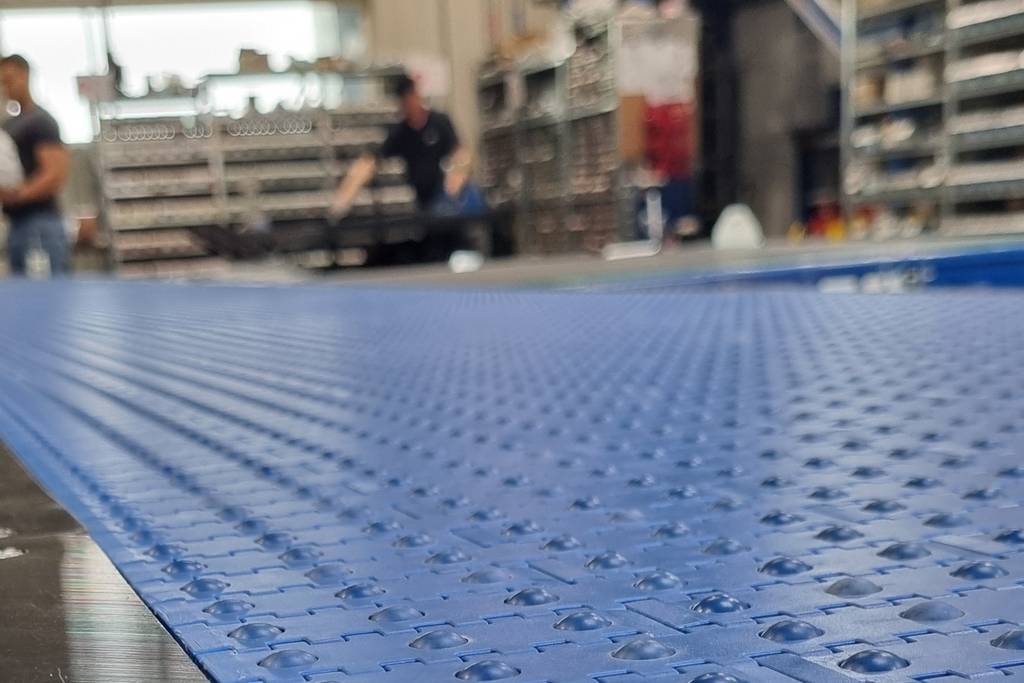
Connecting a new sorter to an existing conveyor is always an area of increased risk. In this case, the device had to be integrated into an existing line. The problem arose very quickly. A gap appeared at the junction of the new sorter and the existing conveyor. Some of the smaller packages did not pass smoothly between conveyor belts, stopping at a junction or falling into a gap.
Standard integration solution? It wasn't compatible. Theoretically, one of the considered options could have been replacing part or all of the existing line, which would have been unjustified from a business perspective.
The final solution? Manufacturing a custom insert to reduce the gap
We decided to solve the problem exactly where it arose. We designed and manufactured a custom insert, reducing the gap between conveyor belts and restoring the smooth flow of shipments. It was not a catalog item or a standard integration component. Our solution was designed for the specific geometry of the line and the warehouse operating conditions. Thanks to our engineering background and production workshop, we were able to proceed from diagnosis to implementation without engaging external subcontractors and without generating additional downtime. In such situations, the difference between „off-the-shelf” integration and intralogistics engineering becomes apparent. At Intralog, we don't expect existing infrastructure to be perfect. We design solutions that work in real-world, often imperfect, warehouse conditions.
Our recipe for effective automation: Error elimination and efficient integration
Automation has completely eliminated human error at the source, and thanks to Intralog's engineering capabilities, it has been possible to efficiently integrate the new solution with the existing infrastructure.
Do you want to know which elements of your sorting process are worth automating and where integrating new solutions will bring the greatest business impact? Contact us.