




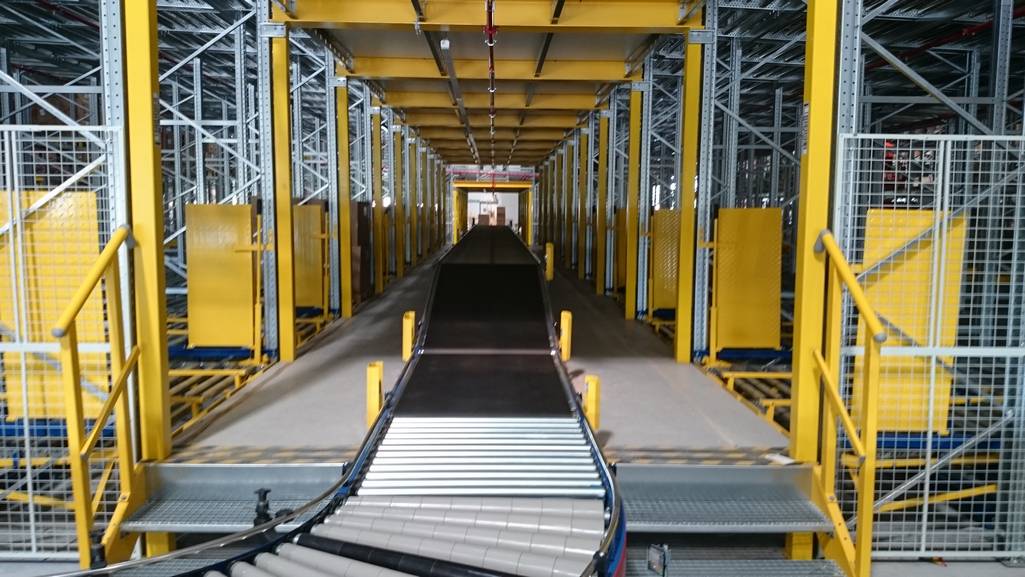
Roller conveyor, belt conveyor, or chain conveyor. Which one to choose to ensure the process runs smoothly and without downtime?
How to make the right choice?
This question arises in many companies that want to streamline the flow of goods and increase warehouse efficiency. At first glance, the decision may seem simple. In practice, choosing internal transport technology is not just a decision catalog, but a strategic choice that influences costs, security, and throughput of the entire process.
That is why in many organizations the key question should not be: What type of conveyor should I choose? Much more important is: JHow to design a system that will truly improve operational efficiency, reduce costs, and ensure stable warehouse operations every day?
Our guide was created to help you make the right and wise decision. In the article below, you will learn:
- In practice, how do belt, roller, and chain conveyors differ?
- How does the choice of a specific technology affect the throughput, cost, and stability of a process?
- What solutions work best for e-commerce, manufacturing, FMCG, and distribution?
- How to align conveyor selection with business objectives, not just technical parameters?
- How do we at Intralog design material flow systems – starting with process analysis and your real business needs?
Choosing the right type of conveyor – why is it so important?
A conveyor system is not just a set of specific devices. It's an entire infrastructure that shapes the way a warehouse operates: its throughput, operational rhythm, and process stability. In practice, this translates directly to:
- order fulfillment time,
- number of errors and complaints,
- operating cost per unit,
- safety and ergonomics,
- Process resilience to seasonality and volume growth.
The selection of conveyors also serves various goals of individual people within the organization.
For the Logistics Director This will primarily increase the throughput and predictability of warehouse operations.
For the warehouse manager – reduction of bottlenecks and better organization of daily goods flow.
For the Chief Financial Officer stable operating costs and a return on investment in automation that is easy to calculate.
However, for the maintenance manager – system reliability, easy maintenance, and minimization of downtime.
Therefore, the selection of conveyors should always begin with a thorough analysis of the entire process. You should examine how the warehouse operates today and how it should operate in one, two, or five years.
Intralog – Conveyor Guide
Time for specifics. Below you will find three key technologies for internal transport and their real impact on the process.
Belt conveyors – fluidity with irregular and delicate products
1. Technical Specification
Conveyor belt a system with a continuous belt made of PVC, rubber, plastics, or modules. It allows for stable, non-slip transport even where the load has no rigid base. It can operate in horizontal, inclined configurations, and as a connecting element between production lines.
When will a belt conveyor be the best choice?
When transporting products:
- irregular;
- soft and prone to damage;
- light or with variable base;
- requiring uniform feeding over long sections.
The most common applications for belt conveyors: e-commerce, packaging, lightweight unit intralogistics, feeding goods to sorters.
3. Key Business Benefits:
- fewer damaged goods;
- Stable long-distance flow;
- less manual intervention;
- predictable warehouse workflow;
- high process repeatability.
Roller Conveyors – Flexibility and Precise Flow Control
1. Technical Specification
Gravity-fed and powered versions are available:
- intra.LS®;
- intra.MOD®;
- intra.POW®.
The systems allow for the construction of tracks with any layout: curves, branches, ZLP accumulation zones.
2. When are roller conveyors the best choice?
When you work with cargo:
- in boxes;
- in KLT boxes;
- in transport containers requiring buffering, sorting, or accumulation.
Roller conveyors They are used in logistics centers, light manufacturing, e-commerce, and anywhere where a fast pace of work and the possibility of integrating automation are important.
3. Key Business Benefits:
- full control over the movement of goods;
- high performance with low energy consumption;
- ability to create accumulation zones;
- Easy integration with WMS, scanners, applicators;
- Quick expansion and layout change without major investment.
Chain conveyors - reliability for heavy loads
1. Technical Specification
Chain conveyors Intralog has been designed to withstand demanding working conditions and heavy loads. The core of the construction is a reinforced, flat 3/4” chain that operates on a 4 mm thick steel frame. This allows the system to easily transport pallets and heavy loads weighing up to 1500 kg per unit.
2. When are chain conveyors the best choice?
When you transport:
- Euro pallets and industrial pallets;
- heavy and metal loads;
- technical containers;
- loads requiring precise positioning.
Chain conveyors are effective in production, receiving areas, automated storage, and places where resistance to harsh operating conditions is required.
3. Key Business Benefits
- Highest reliability in demanding environments;
- stability of heavy cargo transport;
- reduced risk of collision with forklifts;
- fast service and shorter downtimes;
- possibility of integration with depalletizers, stacker cranes, control systems.
How to choose the right type of conveyor? Key criteria
Selecting conveyors is a process that requires analysis:
- Type of cargo – mass, dimensions, stability, fragility.
- Throughput and work character – Constant flow or variable pace.
- Hall layout – distances, obstacles, columns, passage zones.
- Integration with IT systems WMS, WCS, automation, robotics.
- Development plan - scalability for the next 3-5 years.
- Total cost – not only the purchase cost, but also the maintenance and service.
These are the parameters that determine whether the system will work efficiently or become a bottleneck.
7 Key Questions to Ask Clients at the Start
According to the Intralog approach, we always start with the process, not with a presentation of equipment catalogs. The most important questions are:
- What cargo are you transporting?
- How should the workflow look?
- What bandwidth is needed today, and what will be needed in 3–5 years?
- What does the current warehouse or plant layout look like?
- Under what conditions does the device operate?
- What safety and ergonomic requirements need to be considered?
- What systems do the conveyors need to integrate with?
Only on the basis of the answers do we select the appropriate type (or combination of types) of conveyors, designing a system tailored to real business goals, not technical parameters. Do you want to select conveyors for your process? Contact us. We will prepare a flow analysis, select the technology, and design a system that works quickly, safely, and predictably, and most importantly: supports your business.
TAKE A LOOK AT OUR SOCIAL MEDIA: