




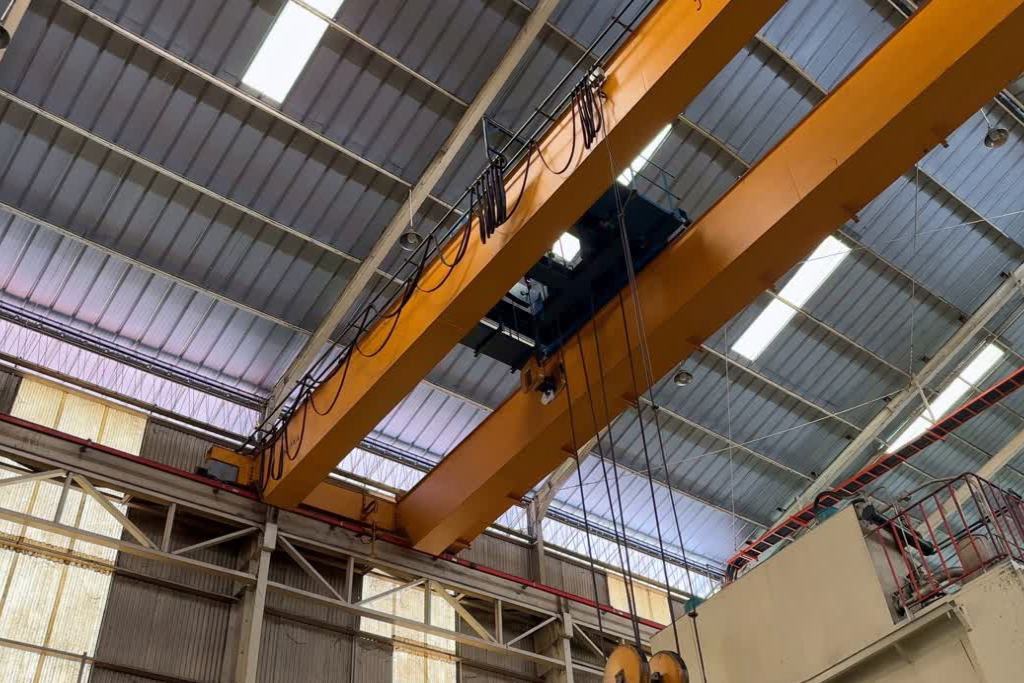
It has everything you need for demanding conditions: steel construction, high load capacity and stability even under heavy use.
Freight crane is a specialized elevator created to transport cargo, pallets and materials Between the floors of a building. Not surprisingly, therefore, it has been a staple solution in warehouses, manufacturing plants, logistics centers and large commercial buildings for years.
The use of a freight crane
Freight cranes are used wherever fast and safe transport of cargo between floors is required. Their design works well in both large industrial facilities and smaller service spaces.
They are most often used:
- In multi-level warehouses and mezzanines.
- In manufacturing plants.
- In logistics centers.
- In big-box stores and shopping malls.
- In technical and industrial facilities.
- In hotels and restaurants.
Thanks to its widespread use, the freight crane has become an indispensable component of the transportation infrastructure of many facilities. At the same time, however, it should be noted that its operation involves strictly defined technical and formal requirements, which in the long run can be challenging for the user.
What should you know before installing a freight crane?
The operation of a freight crane involves a number of formal and technical duties that directly affect its availability, maintenance costs and operational safety. Every freight crane, while extremely practical for daily use, is subject to strict technical supervision. According to the regulations, the owner or manager of the facility must ensure acceptance of the equipment by the UDT, maintain technical records and carry out cyclic inspections. In practice, this means scheduling work with service downtime and operating costs in mind.
Challenges of using freight cranes
The decision to install a freight elevator is not only a financial investment, but also one that requires time, procedures and ongoing technical supervision. After all, each device is subject to strict technical supervision regulations, which entails additional responsibilities for the user.
Responsibilities in the operation of freight cranes:
- Acceptance by UDT - Each crane requires formal approval, which generates additional administrative time and costs.
- Regular inspection and maintenance - All equipment is subject to periodic mandatory inspections, which often mean that work must be stopped.
- High maintenance costs - Hydraulic and drive components require regular replacement, and maintenance is a fixed cost in the operating budget.
- Risk of downtime - Any failure or delay in receiving the UDT affects the continuity of logistics processes and the timeliness of orders.
In practice, this means scheduling downtime, maintenance and operating costs, making it difficult to keep operations running at full capacity. Companies are increasingly looking for solutions that offer the functionality of a freight crane without a UDT, i.e. equipment that does not require technical supervision, but at the same time guarantees the safe transport of loads between levels. Just such a solution is vertical warehouse transportation, which is a modern alternative to freight elevator .
Vertical transporter – a modern alternative to a cargo elevator
The vertical transporter is a device that retains all the advantages of a freight crane, while eliminating its greatest limitations. This is because it does not have a cabin or components that require technical supervision, so it can be put into operation and used immediately after installation.
The most important advantages of the vertical conveyor
Wondering what makes a vertical warehouse conveyor increasingly replace classic cargo cranes? Here are the key reasons why companies are opting for this solution:
- No UDT requirements - The vertical transporter does not transport people, so it is not subject to technical supervision.
- No cabin - The vertical conveyor has a simple, open design that makes it easy to integrate into conveyor systems and production lines.
- No downtime - In addition, it ensures quick installation and immediate readiness for operation.
- Possibility of customized design - Unlike standard cranes, vertical conveyors can be individually adapted to the layout of the hall, the height of the floors and the type of cargo to be transported.
Vertical conveyor and freight elevator - which to choose?
In order to best illustrate the differences between a classic cargo crane and a vertical transporter, it is useful to juxtapose their key parameters. So let's take a look at the key parameters we have included in the comparison table:
| Feature | Freight crane | Vertical conveyor |
| Formalities and documentation | Mandatory technical documentation and periodic inspections | No obligation to report to UDT, minimum formalities |
| Start-up time | Extended – pick-up, approvals, tests | Short - possible installation and startup without acceptance |
| Investment cost | Higher (windshield, cabin, safety features) | Lower – simple construction, no shaft or cab |
| Operating costs | High – mandatory inspections, maintenance, spare parts | Low – minimal maintenance, no mandatory UDT inspections, and reduced component wear. |
| Design flexibility | Limited - design dependent on regulations and cabin dimensions | High – adaptability to hall layout and lifting height |
| Ability to integrate with the transport line | Limited - requires adjustments and safeguards | Full integration with conveyors, sorters and production lines |
| Design | Cab, slides, glass closed | Open load-bearing platform, steel structure |
| Application | Transportation of cargo between floors, such as warehouseantresol-. | Transport pallets, containers and components between levels of a warehouse, mezzanine or production line. |
| Occupational safety | Dependent on UDT regulations and design | Integrated sensor and interlock systems in accordance with industry standards, without UDT requirements. |
| Service availability | Only by companies with UDT authorizations | Standard industrial service, without formal restrictions |
| Assembly | Time-consuming – requires the excavation of a shaft and acceptance | Fast, possible in existing infrastructure |
| Service life | Limited by intensive use and maintenance requirements | Longer – fewer wearing parts |
| Transportation of persons | Not allowed or restricted (depending on the class) | Impossible - for merchandise only |
When it's worth betting on a vertical conveyor
If the transport is between floors of the warehouse, hall and mezzanine, and there is no need to transport people in the unit -. vertical conveyor will be a simpler, cheaper and safer solution.
The freight crane remains a better choice where transportation must also include the operator, such as in tall industrial facilities or when transporting machinery.
But in most warehouse processes:
– from e-commerce to production
– a vertical transporter provides the same functionality with significantly lower formal and financial burden.
Design the conveyor for your process
At Intralog, we do not sell equipment „from a catalog.”.
We create every vertical conveyor project together with the client – analyzing their process, spatial constraints, and logistical requirements.
If you want to see how transport between levels can be simplified in your warehouse
and get back the time wasted on paperwork, let's talk.
We'll show you what the difference looks like in practice – in numbers, not in declarations.
TAKE A LOOK AT OUR SOCIAL MEDIA: